Today woke quite bleary eyed. We had definitely found out what puts the rain in rainforest. The rain had hammered down all night, peeking through the window I could the water raising up bit by bit. I could now understand why the lodges were on stilts. Never, ever have we seen the deluge of rain before. Pete got very giddy and decided to stand underneath it, looking like a continuous ice bucket challenge.
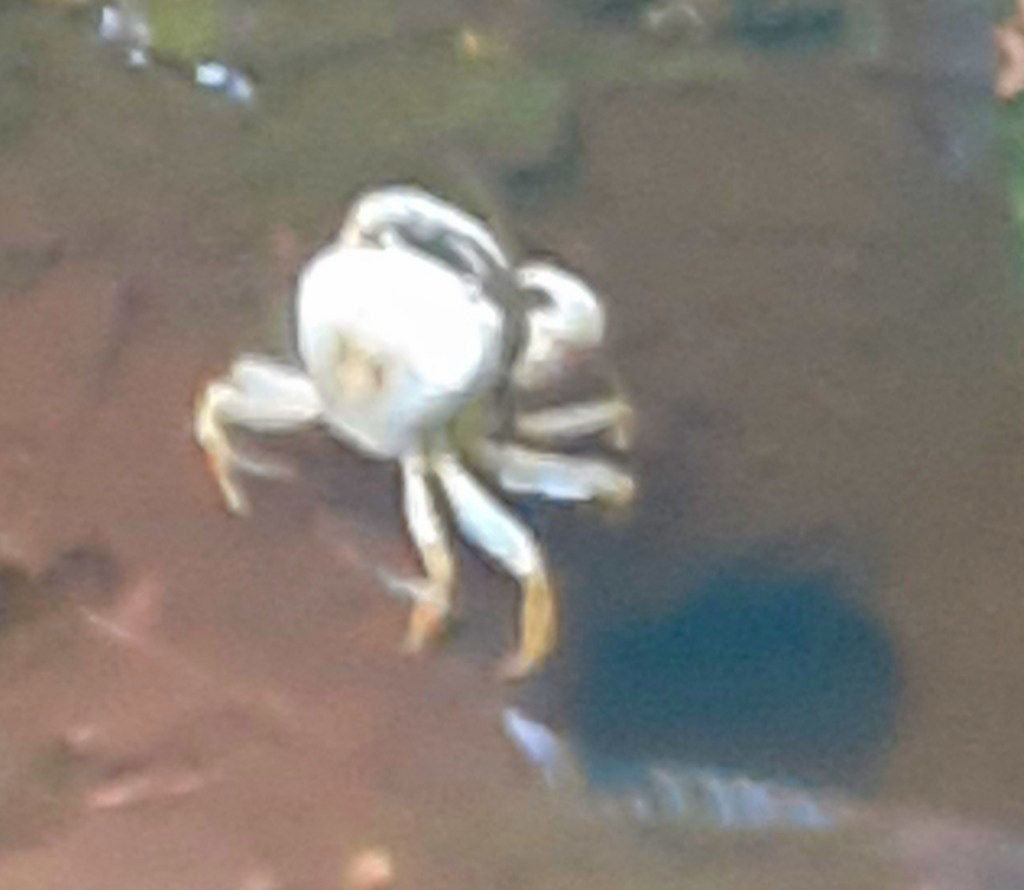
Under the trees were pools of water in the morning. We spied a blue crab. They burrow into the mud, up to five foot. Dotted around you could see tell tale holes which they quickly scurry into.
After another lovely breakfast before the planned activity which was a nature walk. It was still raining but we were undeterred.
Julio was leading the group. As ever full of information as well as putting the fear of God into us all.
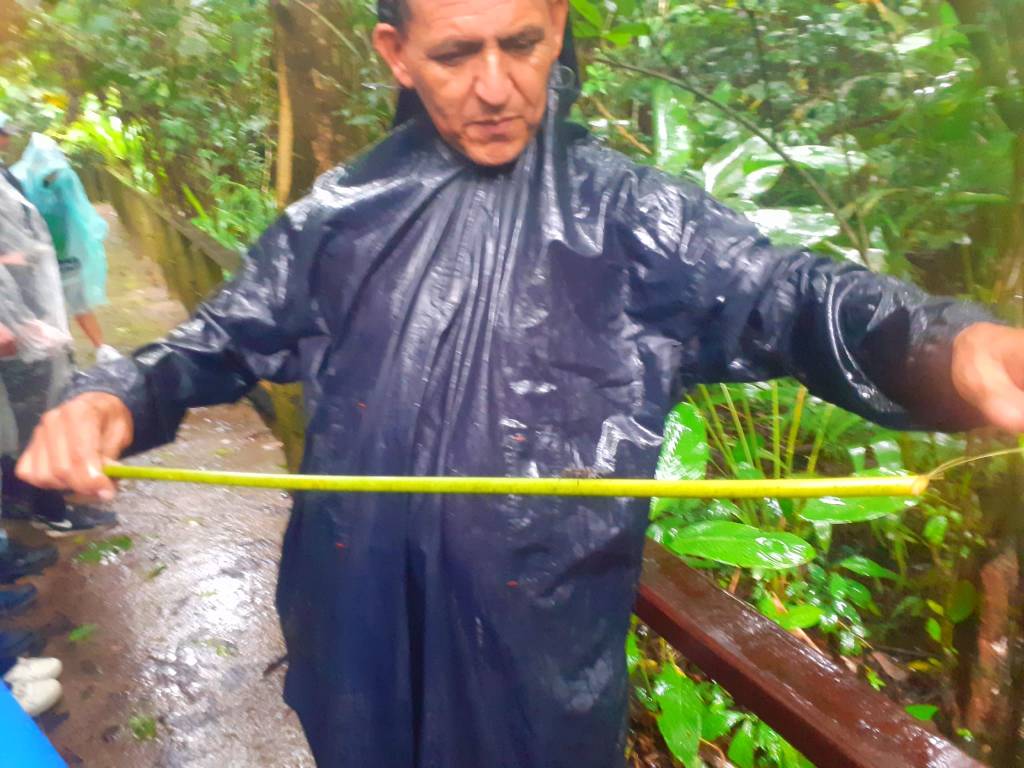
Here he was showing us an ant. He then proceeded to tell us not to put our hands down anywhere, regaling us with a long list of things that could happen to us. Primarily the scourge of the bullet ant. Although nonaggressive, bullet ants will sting when provoked. When one ant stings, it releases chemicals that signal other ants in the vicinity to sting repeatedly. The bullet ant has the most painful sting of any insect, according to the Schmidt Pain Index. The pain is described as blinding, electric pain, comparable to being shot with a gun.
Julio described the time when he was bit and how the pain was unbearable, I promptly kept my arms, hands and everything close to me. Julio then went through everything he had caught, including Dengue fever, which resulted in being wheel chair bound for a few months.
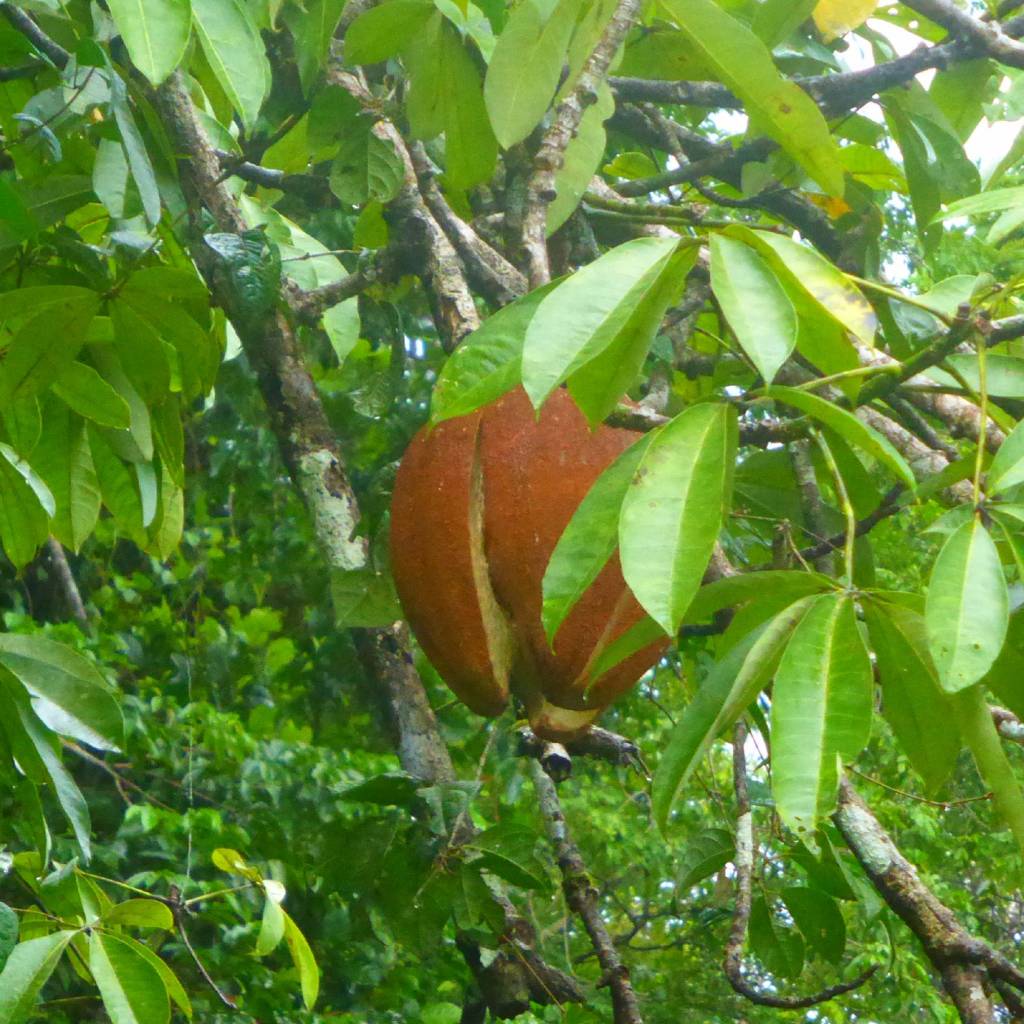
This is the provision fruit from the Pachira tree from which the lodge gets its name.
Julio pointed out the Walking Palm(Socratea exorrha), he said like Socrates was known for pacing aroundMany people believe it can literally walk around (more or less). This is because of its unusual root system; while most trees have one trunk, the palm splits into many smaller roots a few feet off the ground, giving it the appearance of many little legs.
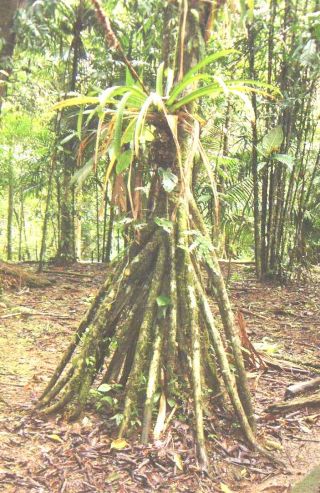
The amazing ambulatory ability of the walking tree is a story that apparently many guides tell in Costa Rica. However, our more recent guide, a naturalist called Gabrielle says it is rubbish, it doesn’t walk, it’s roots just move toward the direction of the sun.
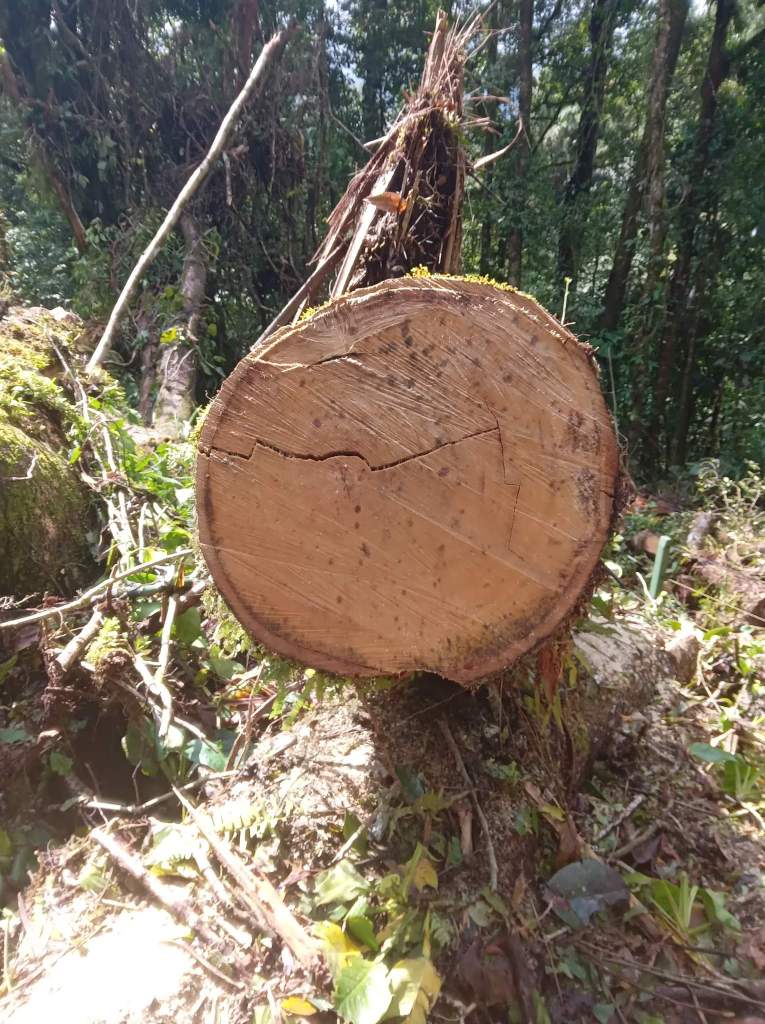
Another thing I found out was that you can guess but you can’t age a tree in the rainforest as it doesn’t have rings. It doesn’t have rings because there isn’t a definite set of seasons, just rainy season and not so rainy season.
It is a shame because there were alot of insects of the biting variety. Pete was getting bitten alive. He now has red constellations of bits across both of legs. Not wanting to be rude we stayed listening as intently as we could muster but should have just headed back to the lodge.
I forgot that we saw a basilisk lizard the previous day. Julio says they are called Jesus Christ lizard in Costa Rica as they walk on water. When frightened by a predator’s approach the lizard will drop to the water and run across the surface. There is a great deal of physics as to why they can walk on water.
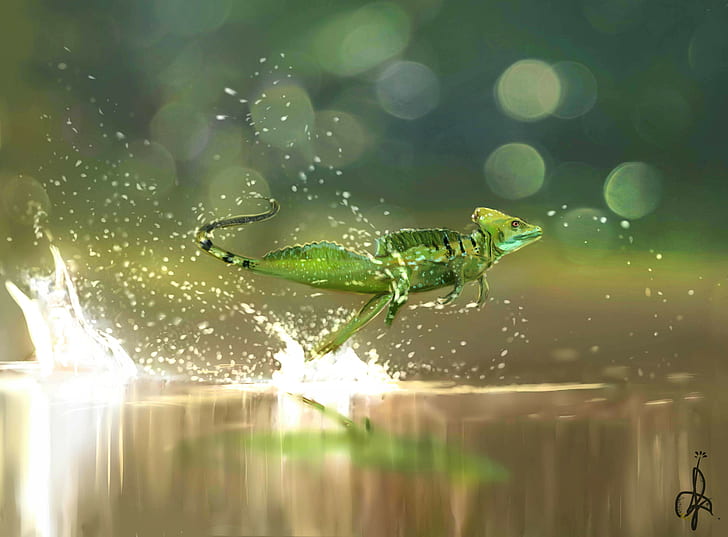
Obviously, this is not a photograph taken by me. The one we saw was happy laying on a leaf.
In the lodge we had breakfast, lunch and dinner, all buffet style – which I prefer. We had to sit with the same people throughout, which was fine as they were all lovely.
The next planned activity was to visit Tortuguero village,Tortuguero meaning turtle catcher. You can walk around without any worries about cars. The paths in the village wind through lush greenery and past wooden houses on stilts with corrugated iron roofs. We walked via the beach.
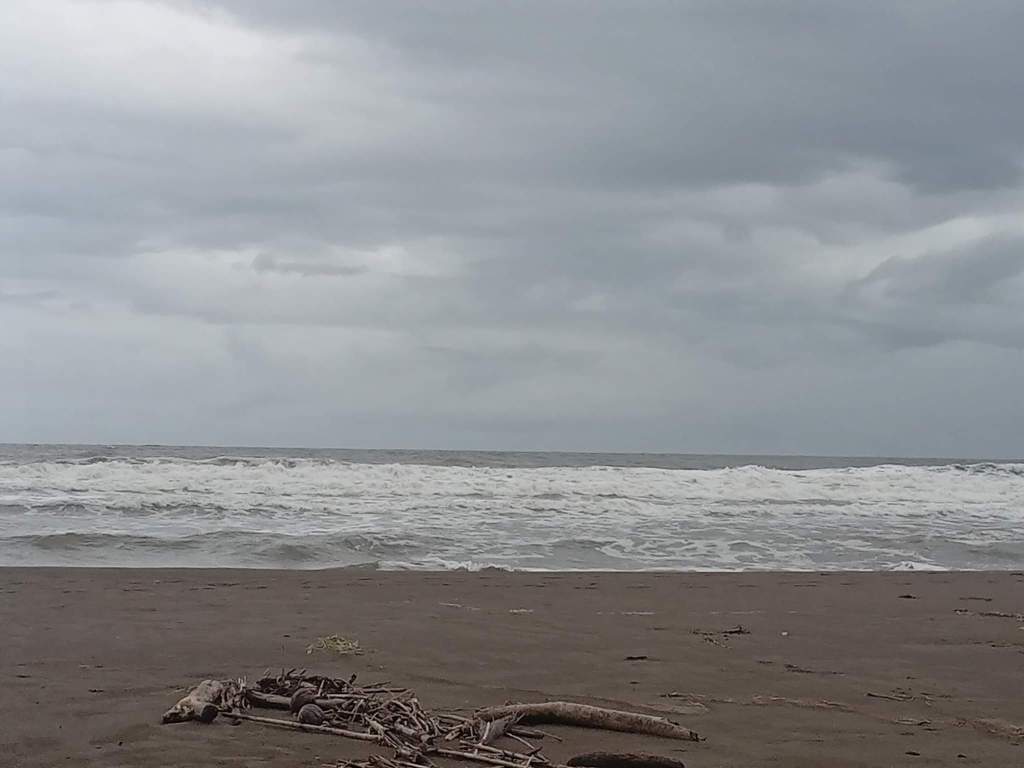
This is the Carribbean Sea. The name “Caribbean” is derived from the Caribs, one of the dominant American Indian groups in the region at the time of European contact during the late 15th century. Again thank you Julio, but please less talking!!!
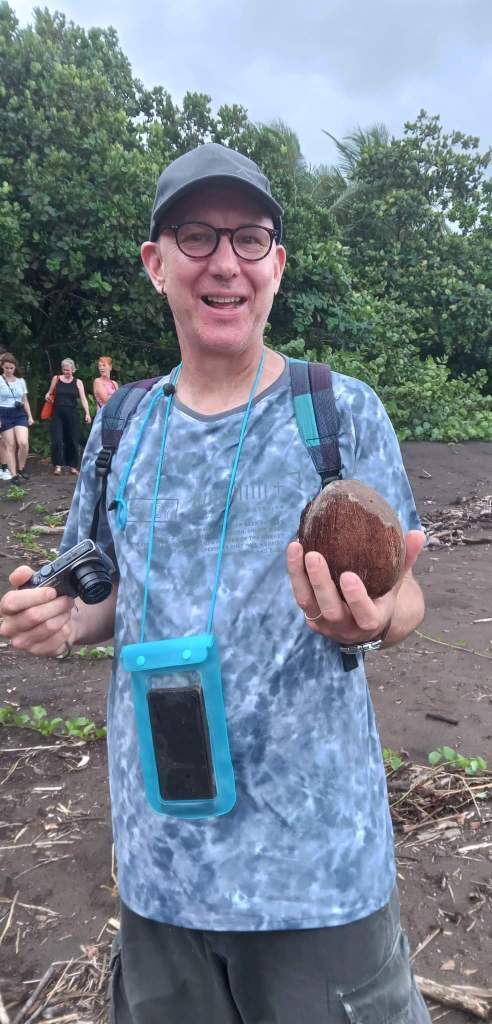
The beach was littered with coconuts that had fallen from the nearby trees,which added to the tropical feel of the place.
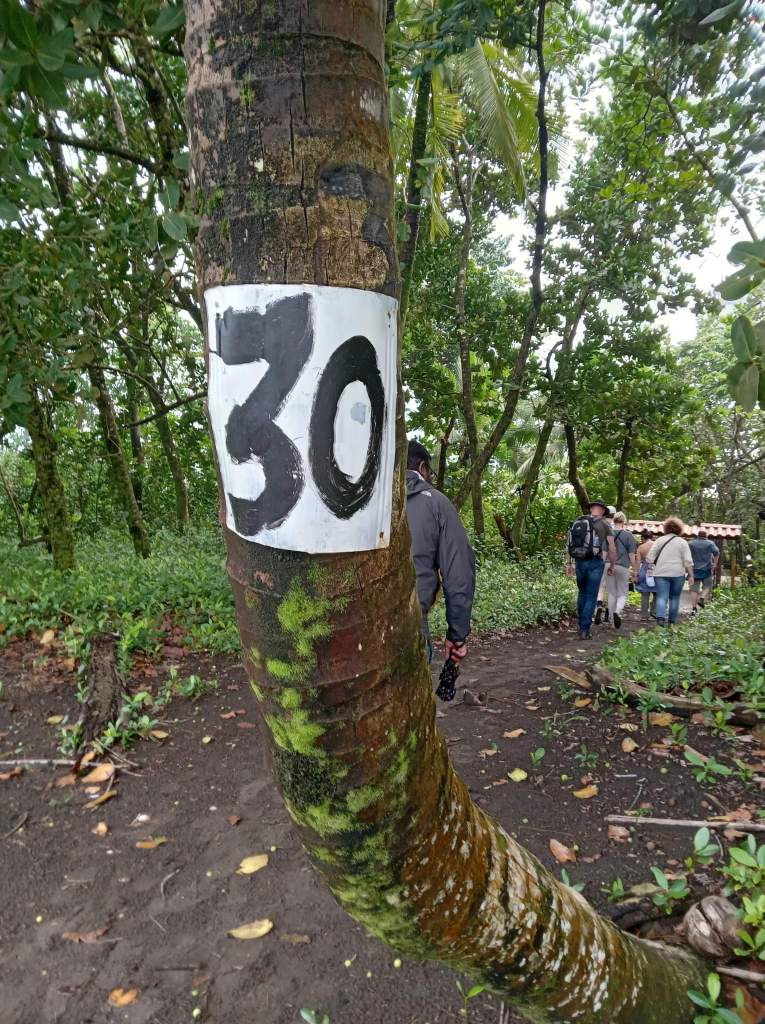
The We left the beach and followed the path to the village. I noticed numbers on the trees as we walked down the path. I would later find out that these numbers were linked to the night time turtle spotting. The beach was split from 1 -60 sections.
Suddenly the group came to a standstill. Someone had spotted a sloth up above in the trees.
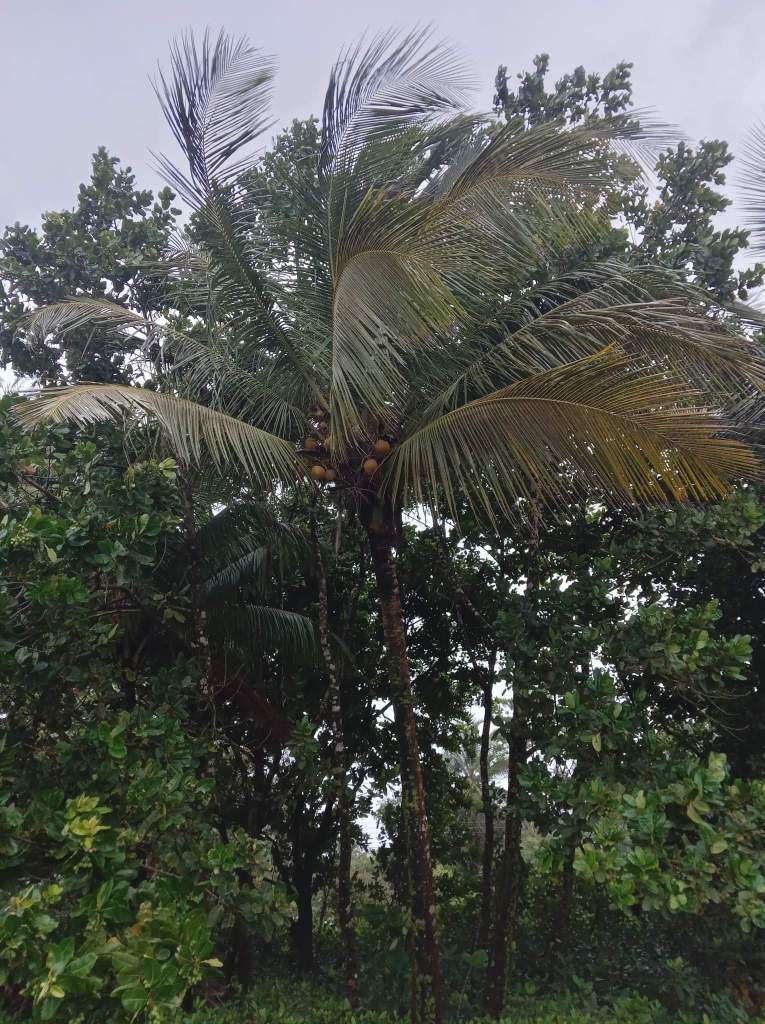
It is there somewhere but as with everything so far on this trip you need to have good eyes!
Julio’s parting shot was to be careful of the coconut juice sellers. One particular one rips tourists off and when challenged waves his machete indiscriminately. Beware said Julio he comes across as lovely but I have seen him use his machete to strike things around him!
Sure enough as we rounded the corner a wild eyed man with a trolley full of coconuts and a machete in hand could be seen. We walked swiftly by and into the colourful village.
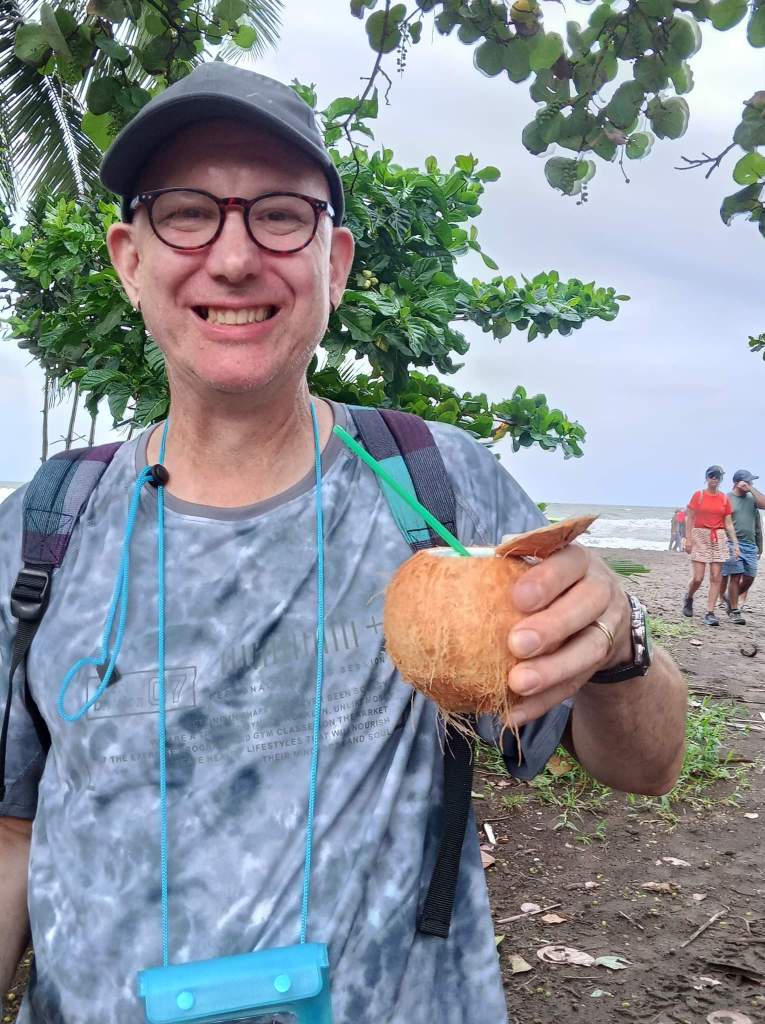
Pete was very excited when we stopped by another coconut juice seller as he has always wanted to drink coconut juice after someone had sliced the top of it. The machete must have been really sharp as it sliced through the coconut like butter.
So much to see, I just went round snapping everything.
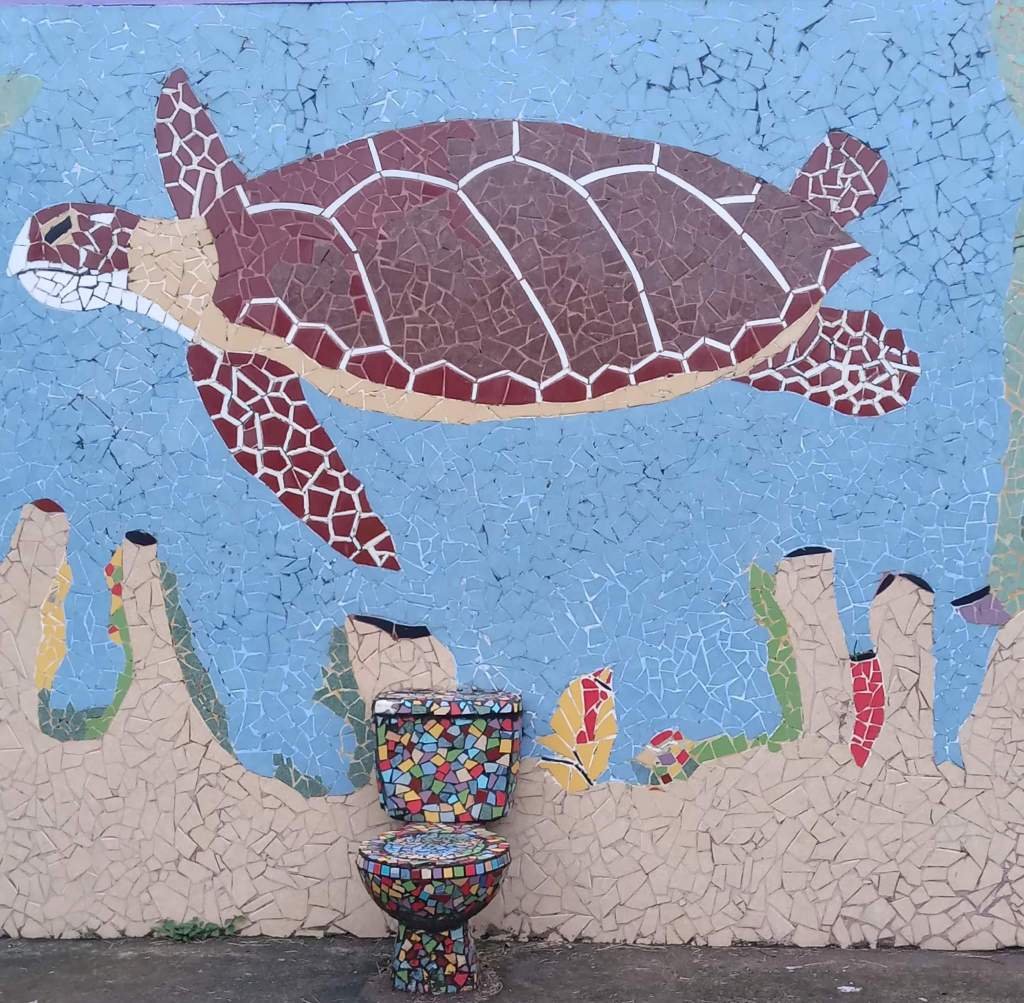
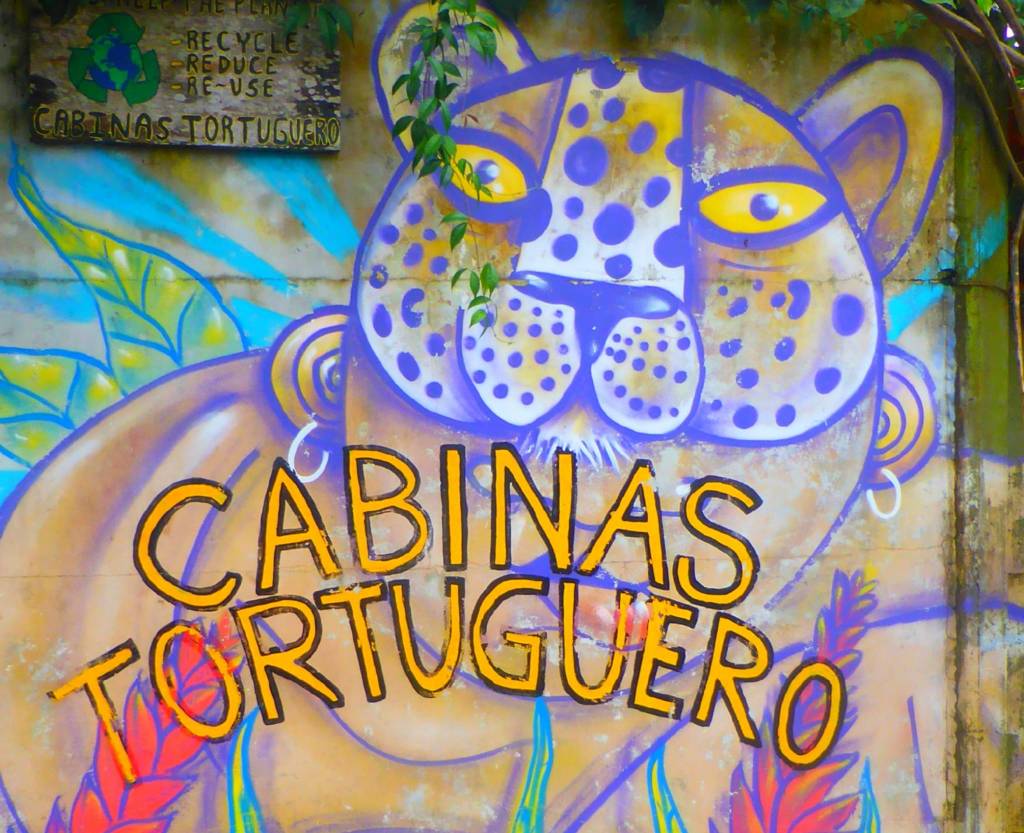
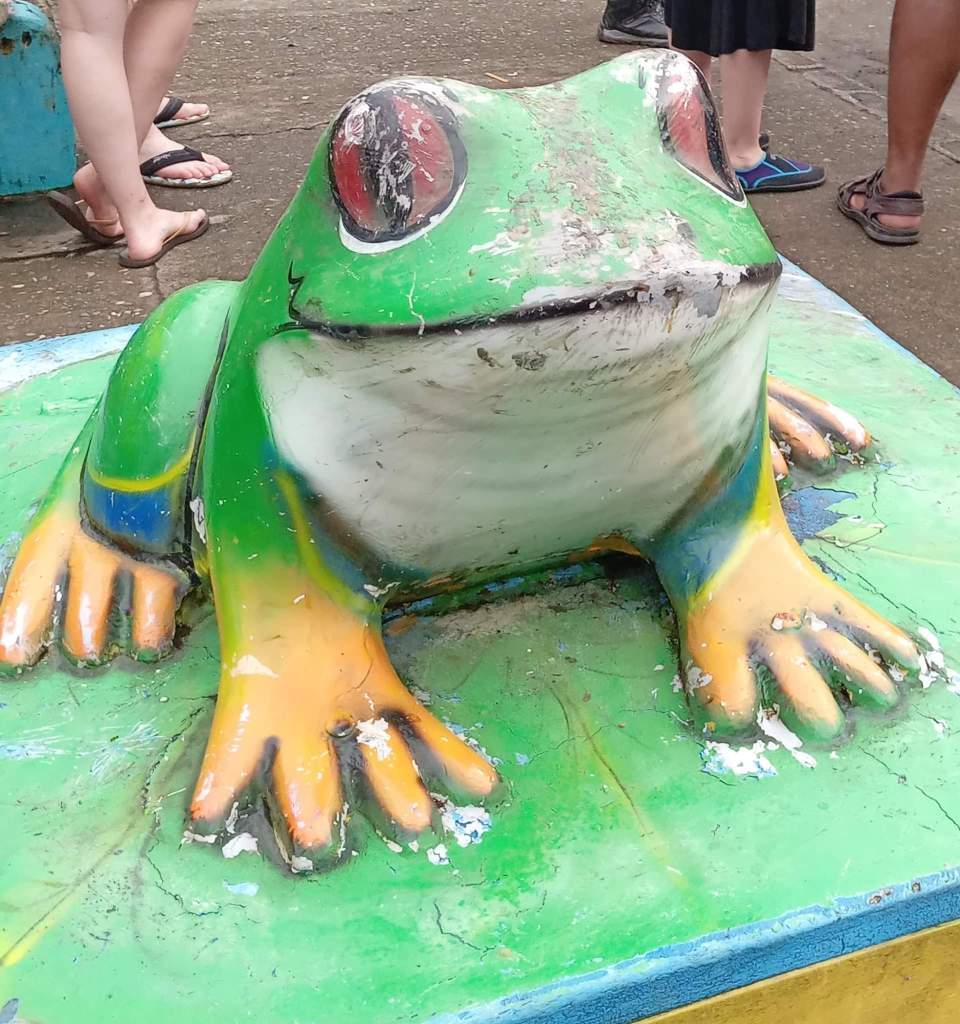

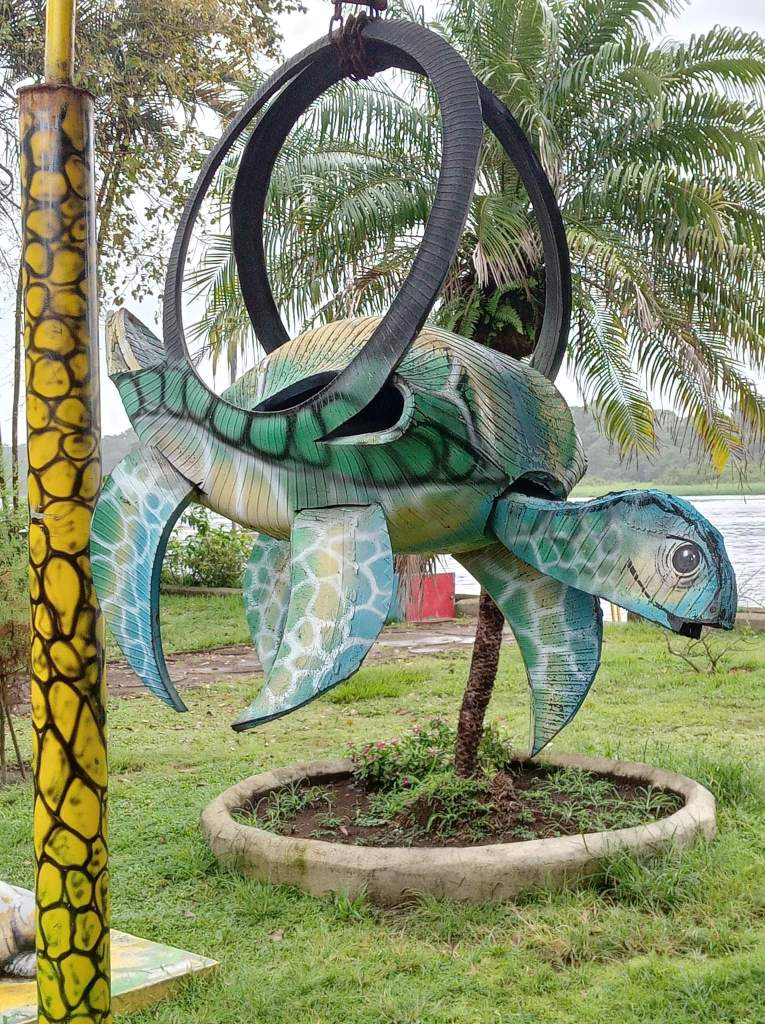
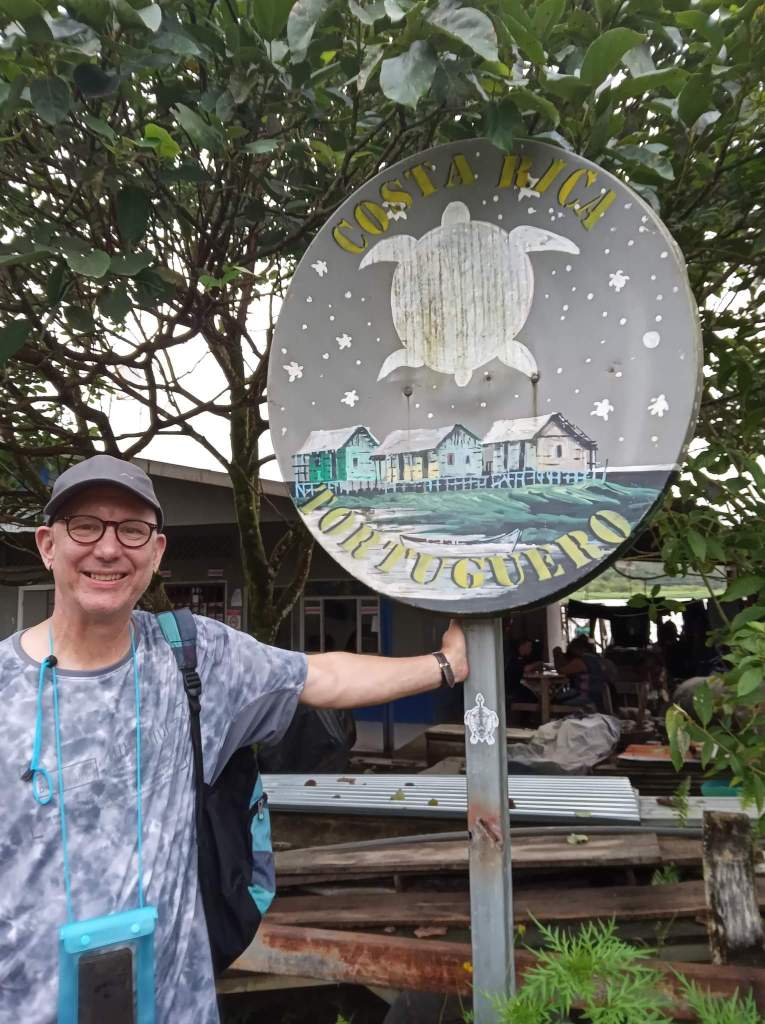

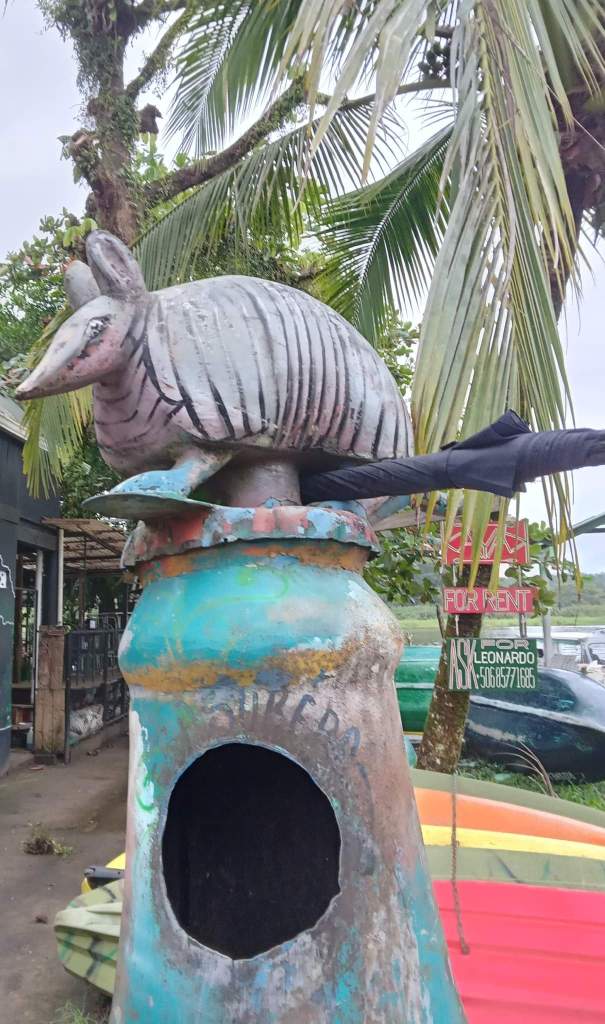
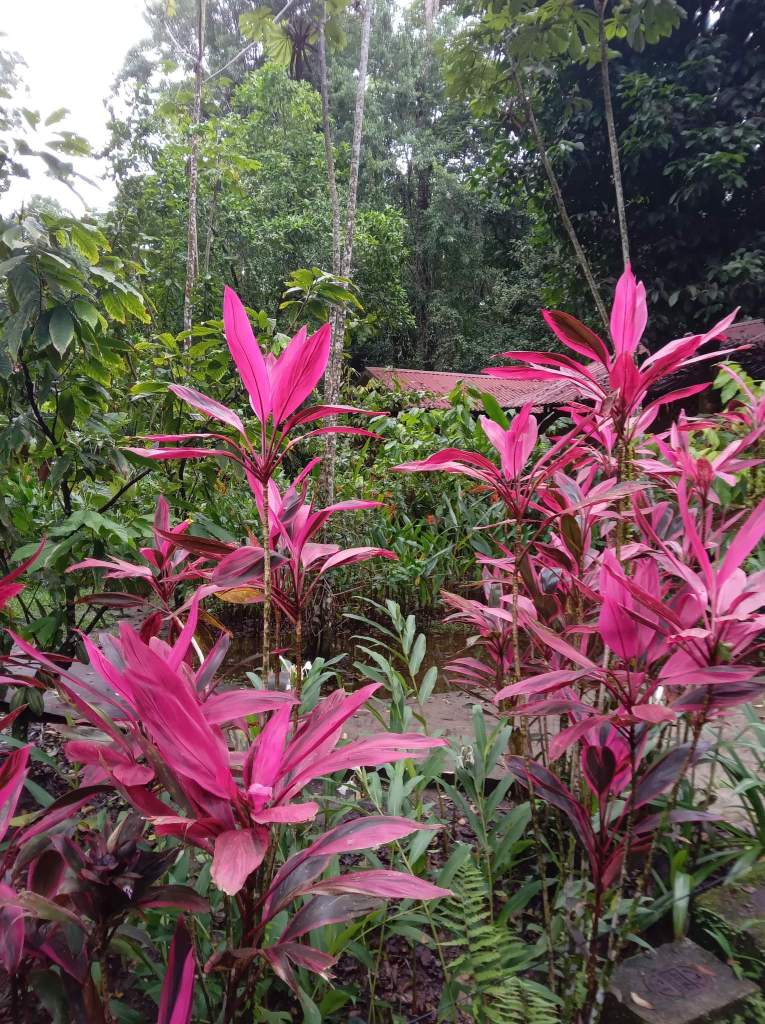
A very colourful and vibrant community on a small strip of land that depend on tourism to make ends meet.
Popped to a cafe by the waterfront to be greeted by hellos from the corner. We had bumped into Sheesh and Joyti (we had met in San Jose). Had a pleasant chat and compared notes ,- they were doing similar trips like us so we were sure our paths would meet sooner or later.
They had done the turtle watching the night before. Just like the couple from Winnipeg, Samantha and Haneep, when they talked about their evening you could tell from their faces that they had experienced a once in a lifetime experience.
We had to go to the lodge reception to find out what time slot we had been given to the turtle watching. It would be either 8 or 10. I was hoping it would be 8 as the one at 10 returned after midnight.
Much relieved to be on the 8 pm slot. There were a number of provisos, we had to wear dark clothes and shoes. Having only brought sandals I wore black flight socks. The rain was torrential and my worry was it would be cancelled. Julio dismissed this, the turtles come from the water, what do they care!
Crossing the canal to the Tortuguero side in the dark was really exciting. It was only in the dark that I could see other lodges because of their lights, during the day they are neatly nestled within the trees and can’t be seen. Our tour guide would be Henry. We immediately warned to Henry, knowledgeable but succinct. He led us to a station. For this part we could wear head torches as it was pitch black. The station had three other groups made up of 10 people and a guide. As we made our way there we passed a couple a what I assume were special police. The whole process is monitored and regulated.
We would be led to the beach only when a guide who works for the government spotted a turtle. At that point we would follow Henry who could only use a small red light to direct us. We could not use any head torches etc. If the turtles saw any lights they would get confused and would head back to the sea – breaking the cycle of their egg laying.
We waited and waited at the station with no guarantee of seeing anything. The excitement was palpable and everyone talked in hushed tones.
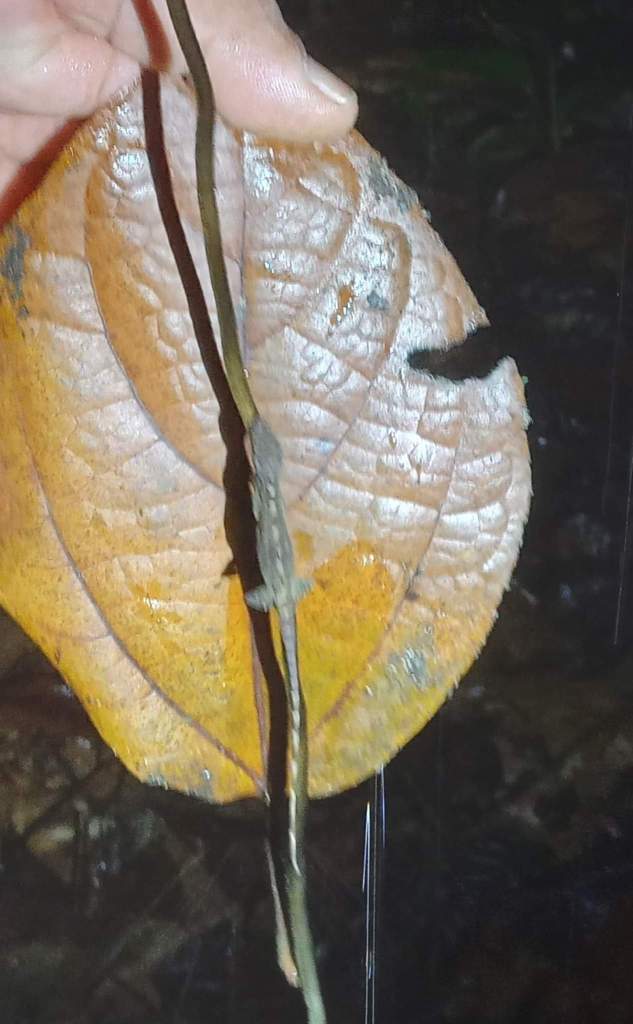
Spotted this cute little lizard while waiting.
Henry had been radioed. It was all hands on deck as we quietly and uniformly followed him to the beach. So dark as the night was cloudy.
A few feet away from the green turtle Henry asked us to huddle round. ” Right,” he whispered, ” these are your friends, you will need to get very close now, five of you will need to crouch and five of you will need to come closer above them. When I saw move. You move as one.” The call was somehow given, not by walky talky but by some sort of instinct between the guides.
As one we moved. Henry pointed for me to crouch, I was literally less than 10 centimetres from the green turtle as it lay it’s eggs. It was unbelievable watching the turtle laying these perfect golf ball eggs, one after another into the hole it had dug with it flippers. We watched silently as the turtle then began use its flippers to cover the eggs.
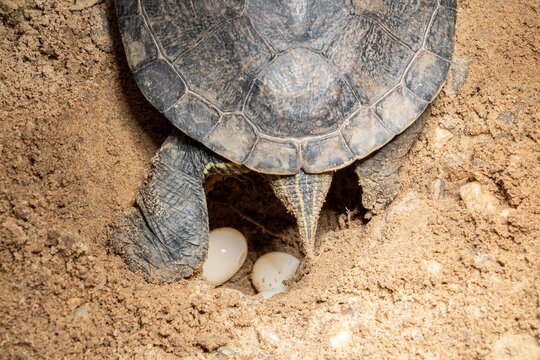
This is just a stock image as we couldn’t understandably take photographs. On that night there were more eggs in the hole as she was coming to the end of laying her eggs, there were around 50 plus eggs. The turtle itself was massive although Henry said it was relatively young as it was only about 40 years old! When the turtles are laying eggs they go into a trance like state , which they must not be disturbed from, this would risk them abandoning their eggs. That’s why we all had to be positioned behind the turtle.
Henry said that the turtle will come to the beach up the four times every two weeks during this period. Initially laying up to 120 eggs and with each visit it lessens. They come to this beach every two years to go through this life cycle. Henry said that out of 1000 eggs only one will survive, he explained that if any more survived it would harm the balance of nature. Pete later found out that the eggs at the bottom of the next become male turtles and the ones at the top female, of it could be the other way round!
As well as the green turtle the giant leatherback, hawksbill, and loggerhead turtles also nest at Tortuguero. The green turtle population is believed to have come perilously close to extinction in the 1960s when nearly every female turtle arriving to nest in Tortuguero was taken for the export market for turtle soup. The picture now is far more positive as this is a sanctuary for all turtles and closely regulated.
On the boat trip back we just couldn’t believe what we had seen. Utterly amazing!
 Random Acts of Travelling